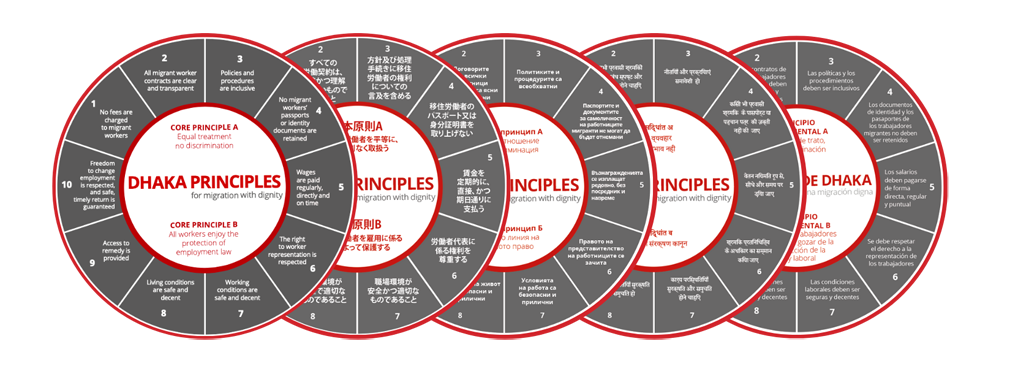

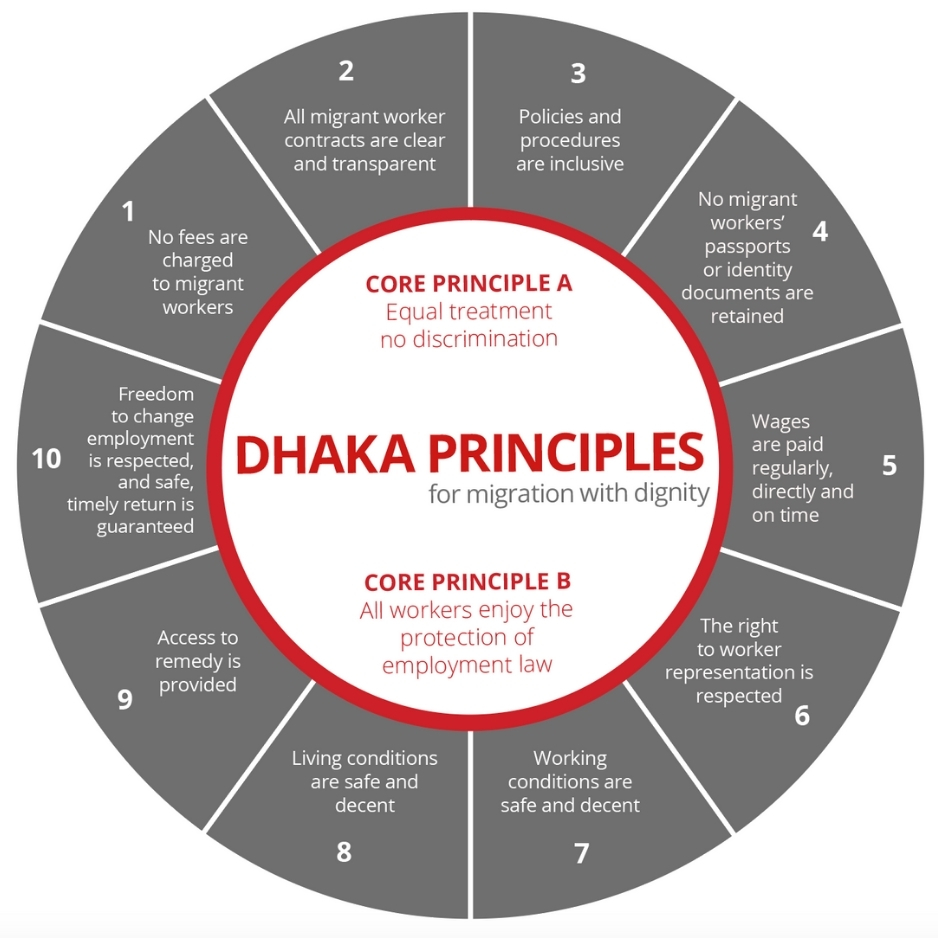
| Core Principle A | All workers are treated equally and without discrimination
Migrant workers should be treated no less favourably than other workers performing the same or similar work. Moreover, migrant workers should be protected from any discrimination that would constitute a violation of human rights. |
| Core Principle B | All workers enjoy the protection of employment law
Migrant workers should have a legally recognised employment relationship with an identifiable and legitimate employer in the country where the work is performed. |
| Principle 1 | No fees are charged to workers
The employer should bear the full costs of recruitment and placement. Migrant workers are not charged any fees for recruitment or placement. |
| Principle 2 | All worker contracts are clear and transparent
Migrant workers should be provided with written contracts in a language each worker understands, with all terms and conditions explained clearly, and the worker’s assent obtained without coercion. |
| Principle 3 | Policies and procedures are inclusive
Migrant workers’ rights should be explicitly referred to in employer and migrant recruiter public human rights policy statements, relevant operational policies and procedures addressing human rights responsibilities. |
| Principle 4 | No workers’ passports or identity documents are retained
Migrant workers should have free and complete access to their own passport, identity documents, and residency papers, and enjoy freedom of movement. |
| Principle 5 | Wages are paid regularly, directly and on time
Migrant workers should be paid what they are due on time, regularly and directly. |
| Principle 6 | The right to worker representation is respected
Migrant workers should have the same rights to join and form trade unions and to bargain collectively as other workers. |
| Principle 7 | Working conditions are safe and decent
Migrant workers should enjoy safe and decent conditions of work, free from harassment, any form of intimidation or inhuman treatment. They should receive adequate health and safety provision and training in relevant languages. |
| Principle 8 | Living conditions are safe and decent
Migrant workers should enjoy safe and hygienic living conditions, and safe transport between the workplace and their accommodation. Migrant workers should not be denied freedom of movement, or confined to their living quarters. |
| Principle 9 | Access to remedy is provided
Migrant workers should have access to judicial remedy and to credible grievance mechanisms, without fear of recrimination or dismissal. |
| Principle 10 | Freedom to change employment is respected, and safe, timely return is guaranteed
Migrant workers should be guaranteed provision for return home on contract completion and in exceptional situations. They should not, however, be prevented from seeking or changing employment in the host country on completion of first contract or after two years, whichever is less. |
The Dhaka Principles for Migration with Dignity are a set of human rights based principles to enhance respect for the rights of migrant workers from the moment of recruitment, during overseas employment and through to further employment or safe return to home countries. They are intended for use by all industry sectors and in any country where workers migrate either inwards or outwards.
They are based on the UN Guiding Principles on Business and Human Rights and international labour and human rights standards. The Dhaka Principles provide a roadmap that traces the worker from home to place of employment and back again and provides key principles that employers and migrant recruiters should respect at each stage in the process to ensure migration with dignity.
The Dhaka Principles were officially launched on International Migrants Day, 18th December 2012.
The Dhaka Principles were developed by the Institute for Human Rights and Business in consultation with a range of stakeholders from business, government, trade unions and civil society. The first draft was shared publicly at a migration roundtable in Dhaka, Bangladesh, June 2011. IHRB continues to manage and promote the Dhaka Principles globally.
The Institute for Human Rights and Business (IHRB) is dedicated to being a global centre of excellence and expertise on the relationship between business and internationally proclaimed human rights standards.
It provides a trusted, impartial space for dialogue and independent analysis to deepen understanding of human rights challenges and issues and the appropriate role of business.
It seeks to address problems where the law may be unclear, where accountability and responsibility may not be well-defined, and where legitimate dispute settlement mechanisms may be non-existent or poorly-administered. IHRB works to raise corporate standards and strengthen public policy to ensure that the activities of companies do not contribute to human rights abuses, and in fact lead to positive outcomes.
Neill Wilkins – Migration Programme Officer, Institute for Human Rights and Business
neill.wilkins@ihrb.org
Please contact Neill for all general enquiries relating to the Dhaka Principles and the IHRB Migration Programme
Dr Katharine Jones – Migration Programme Consultant, Institute for Human Rights and Business
katharine.jones@ihrb.org
Please contact Katharine for all academic enquiries relating to the Dhaka Principles and the IHRB Migration Programme
Read more about the Institute for Human Rights Migration Programme
The need by business for a set of overarching principles relating to migrant workers was established during a programme of multi-stakeholder roundtables convened by Institute for Human Rights and Business and other partners in the UK, Mauritius, Bangladesh and Delhi between 2009 and 2012. Input and feedback from all the roundtable participants and beyond have been an important part of their formulation. Roundtable reports Link
In addition the Dhaka Principles draw inspiration and guidance from the related work of:
Business for Social Responsibility
The final version of the Dhaka Principles were formulated in close consultation with the International Trade Union Confederation.
IHRB are also particularly grateful for the review and specific feedback offered during the consultation process by the following organisations:
Business:
Adidas, BAIRA - Bangladesh Association of International Recruiting Agencies, CIETT – International Confederation of Recruitment Agencies, CMT - Compagnie Mauricienne de Textile Ltée, Coca Cola, Jones Group, ManpowerGroup, Next, Nike
Civil Society and Government:
AWAJ, Centre for North East Studies – Jamia Millia Islamia (India), Clean Clothes Campaign, DFID – Department for Foreign Investment and Development (UK), Ethical Trading Initiative, Monitoring Sustainability of Globalisation, ILO – International Labour Organisation, CARD - Overseas Filipino Workers Hong Kong Foundation, PICUM – Platform for International Cooperation on Undocumented Migrants, RMMRU – Refugee and Migratory Movements Research Unit.
We have made every effort to ensure that these translations are as complete and accurate as possible. Please note, however, that in all cases, it is the English language version that should be treated as the original and definitive version in case of inconsistencies between the different linguistic versions of the document.
Anti-slavery International
Works at all levels local, national and international to eliminate all kinds of slavery around the world.
Business For Social Responsibility (BSR)
BSR member companies work together to develop sustainable business strategies and solutions through consultation, research and cross sector collaboration. The ILM focus group examines the role for business around migration issues.
Business & Human Rights Resource Centre
The world’s leading independent resource on the subject. Their website is updated hourly with news and reports about companies’ human rights impacts worldwide – positive and negative.
Clean Clothes Campaign
An international alliance of unions and NGOs which seeks to improve working conditions and support the empowerment of workers in the global garment and sportswear industries.
End Human Trafficking Now
Campaign which seeks to involve business in efforts to prevent human trafficking.
Ethical Trading Initiative
Alliance of companies, trade unions and voluntary organisations. Focus on improving the working conditions and lives of those who manufacture, grow or process consumer goods.
Fair Labor Association
A non-profit organisation dedicated to ending sweatshop conditions in factories worldwide.
Global Alliance Against Traffic in Women
Alliance of 106 NGOs promoting the rights of women migrant workers and trafficked women.
The International Business Leaders Forum
An independent, not for profit organisation working with business, governments and civil society to enhance the contribution that companies can make to sustainable development
International Trade Union Confederation (ITUC)
International confederation of trade unions seeking to improve co-operation and collaboration amongst unions. Seeks also to provide a united international focus to campaigning and lobbying for workers rights.
Migrant Forum in Asia
MFA is a regional network of non-government organizations (NGOs), associations and trade unions of migrant workers, and individual advocates in Asia who are committed to protect and promote the rights and welfare of migrant workers
Nimbus / Vivhaan
Organisation that uses technology, cloud computing and mobile communications to empower grassroots communities in India with a particular focus on trafficking and migration.
Not For Sale Campaign
Grassroots multi-stakeholder coalition of activists campaigning against human trafficking and slavery
PICUM – Platform for International Cooperation on Undocumented Migrants
A non-governmental organisation that aims to promote respect for the human rights of undocumented migrants within Europe.
Staff Wanted Initiative
The Staff Wanted Initiative seeks to raise awareness within the UK hospitality industry of the steps needed to combat the exploitation of vulnerable (mostly migrant) workers, trafficking and forced labour.
Walk Free
Walk Free – The movement to end modern slavery aims to amplify and extend the efforts of the many groups committed to tackling slavery. By gathering a global membership, using social networks and new technologies, and organizing campaigns and communities online and on the ground.
Gangmasters Licensing Authority (GLA) (UK)
Regulates those who supply labour or use workers to provide services in agriculture, forestry, horticulture, shellfish gathering and food processing and packaging in the UK. Note: Offers a unique model of regulation brought about by multi-stakeholder collaboration.
The Global Compact - Human Rights Dilemmas Forum - Migrant Workers
The UN Global Compact Forum, designed to stimulate discussion about the dilemmas responsible multi-national companies may face in their efforts to respect and support human rights when operating in emerging economies.
Global Forum On Migration and Development (GFMD)
UN orchestrated international forum on migration and development. Includes civil society days as an entry point for wider civil society participation by business and NGOs.
The Hague Process
The 2002 Declaration of The Hague on the Future of Refugee and Migration Policy is based on the vision of a just world where refugees and migrants contribute to economic and social development, cultural richness and diversity without suffering discrimination and human rights violations. The Hague Process on Refugees and Migration (Foundation THP) has as its mission to support the implementation of this Declaration.
International Labour Organisation (ILO)
UN specialized agency which seeks the promotion of social justice and internationally recognized labour and human rights.
International Organisation for Migration IOM
IOM is the leading inter-governmental organisation in the field of migration and works closely with governmental, intergovernmental and non-governmental partners.
CIETT - International Confederation of Private Employment Agencies
Ciett is a confederation of 42 national federations of private employment agencies and 6 of the largest staffing companies worldwide: Adecco, Hudson, Kelly Services, Manpower, Randstad and USG People.
Its stated objective is to help its members conduct their businesses in a legal and regulatory environment that is positive and supportive worldwide.
Asia Pacific Migration Research Network
The APMRN was established in 1995 as a research project of the Management of Social Transformations (MOST) Programme of UNESCO. The APMRN is a collaborative organisation of researchers and scholars interested in all aspects of migration.
Centre On Migration Policy And Society - COMPAS
Based at Oxford University -Conducts high quality research, to develop theory, inform public opinion and evaluate policy.
European Migration Network
The overall objective of the EMN is to improve the availability of, and access to, information concerning migration and asylum at European and Member State level in order to support policy- and decision-making in the EU.
Graduate Institute Geneva
An academic institution with a worldwide reputation within the fields of international development, migration and human rights.
International Migration Institute
Based at Oxford University – Seeks to contribute to the development of new theoretical and methodological approaches to migration research.
Institute for Migration and Ethnic Studies (IMES)
The Institute for Migration and Ethnic Studies (IMES) is an interdisciplinary research institute that focuses on issues related to migration and integration from an international and comparative perspective. The institute works closely with other national and international academic institutes and organisations in the field of migration. The Network Office of the Network of Excellence IMISCOE and the European Secretariat of Metropolis International are both located at IMES.
Migration Policy Institute
Independent, non-profit, non-partisan think-tank dedicated to the study of the movement of people worldwide. Comprehensive statistics, analysis and reports.
Migration Policy Group
Independent non-profit European organisation committed to contributing to lasting and positive change resulting in open and inclusive societies. MPG stimulates well-informed European policy debate, cooperation and action on migration and related issues.
The Refugee and Migratory Movements Research Unit (RMMRU)
RMMRU is an affiliate of the University of Dhaka and has been functioning as a research, training, and policy advocacy institution since 1996. Its primary focus has been on migration, refugee, displacement, and governance issues.
Sussex Centre for Migration Research
Based at Sussex University -Co-ordinate DFID-funded centre on Migration,Globalisation and Poverty and other externally-funded research projects. Provide doctoral and masters-level training in Migration Studies, and also publish the internationally-recognised Journal of Ethnic and Migration Studies.
The Dhaka Principles are informed by and complementary to a number of key international conventions and codes:
UN Guiding Principles on Business and Human Rights
The Dhaka Principles seek to align business and state practice regarding migrant workers with the UN Guiding Principles For Business (Protect, Respect, Remedy framework) developed by UN Special Representative for Business and Human Rights, Professor John Ruggie and unanimously endorsed by the UN Human Rights Council in 2011.
United Nations Office for Human Rights (UNOHR)
UN Convention on the Rights of all Migrant Workers and their families
International Labour Organization (ILO)
ILO Multilateral Framework on Labour Migration
Non-binding principles and guidelines for a rights-based approach to labour migration. Although aimed at policy-makers this framework aims to assist governments, social partners and stakeholders including business in their efforts to manage labour migration and protect migrant workers. The ILO Multilateral Framework on Labour Migration provides a comprehensive set of rights-based guidelines and principles as a global compilation of good practices on labour migration developed by governments and social partners.
The ILO also has a number of conventions around migrant workers. They focus mostly on the establishment of a clear set of principles agreed by ratifying countries. They form a legal baseline for many international standards.
The Dhaka Principles also align with 2 key international business codes:
Ethical Trading Initiative
ETI Base Code
The ETI base code is an internationally recognised code of labour practice. It is founded on the conventions of the ILO but presents them in an easily understandable 9 point format. All the recommendations of the base code should apply equally to both migrant and indigenous workers. It is the responsibility of business to undertake effective due diligence to ensure that, despite their enhanced vulnerability to abuse, migrant workers are protected by this code. The code also provides a useful lens through which to view the activities of other parties such as recruitment agencies.
CIETT International Confederation of Private Employment Agencies
CIETT Members Code of Conduct
CIETT are the international body representing private employment agencies in 42 countries worldwide. Their guidelines seek to establish clear standards of professionalism and adherence to ILO conventions and international law. In particular CIETT have a clear policy that no fee should be charged to any worker by any agency for placement and that that cost should be borne by the employer.
Migrant workers often experience unequal treatment in many aspects of their employment. They are frequently paid less than other workers and perform work under less favourable conditions. These conditions can include lower rates of compensation including overtime rates, less favourable working times, little or no access to training or promotion, less protection from workplace hazards, unfavourable allocation of tasks, discipline, less access to health care and social protection, or the provisions of collective agreements that apply to other workers performing the same or similar work. Such practices can render migrant workers a second or lower tier of the workforce.
Migrant workers are frequently discriminated against in other ways, ranging from disregard for religious beliefs, cultural practices and dietary requirements, to wider discrimination on the basis of their race, colour, caste, sex, sexual orientation, maternity, religion, health, political opinion, national extraction, or social origin. In countries where forms of discrimination are legally sanctioned, employers or migrant recruiters sometimes violate the human rights of migrant workers and justify it on the basis of the national law or the legal status of the worker.
Some categories of migrant workers are acutely vulnerable to unequal treatment. Migrant workers who become undocumented through no fault of their own, such as married women who lose their legal status upon a husband’s death, are at particular risk. Employers have been known to take advantage of this undocumented status and to discriminate against workers under threat of deportation. Migrant workers that become pregnant are also often dismissed without payment of outstanding wages or the means to travel home. These workers often lack access to any form of legal protection or remedy and are particularly vulnerable to further exploitation.
Download PDF of complete text for this principle |
Download PDF of complete text for ALL principles
Migrant workers are vulnerable to abuse without the protection of law, and are at particular risk where the placement and recruitment of workers is outsourced to third parties that are not legally recognised as employers in the country where the work is performed. The principle means by which workers are protected is through labour or employment law, which is distinct from the law that applies to commercial relationships. The application of labour or employment law is based on the recognition of an employment relationship, which creates a legal link between the employee and the employer. Employment law is usually designed to protect the rights and outline the responsibilities of workers and employers and creates a framework to ensure that workers have protection from exploitation, while recognising the mutual obligations of both parties to uphold the terms of any contract between them. Irrespective of how the law is defined in a particular country, the employment relationship is a universal concept. It is among the most important means by which society ensures that workers’ rights are protected and employment relationships are fair and just.
Much of the exploitation and abuse of migrant workers is possible because the work is performed outside of the legal framework intended to protect workers. In order for workers to have the protection of law and access to justice their work must be performed within a legal framework in the country in which the work is undertaken. Because both parties in an employment relationship must be recognised, the employer must be identifiable and legally recognised as such within the country where the work is performed. The employer must be a business enterprise capable of assuming the legal obligations of the employer established in national law. With respect to domestic work the employer need not be a business enterprise but needs to be capable of assuming the legal obligations of an employer.
Download PDF of complete text for this principle |
Download PDF of complete text for ALL principles
Migrant recruiters frequently charge fees to workers for recruitment and placement. Placement fees may include travel, visa and administrative costs, and other assorted unspecified ‘fees’ and ‘service charges’. Sometimes the fees are treated as loans with high rates of compound interest. These practices lead many migrant workers into heavy debt to secure a job and can increase vulnerability to exploitation, including debt bondage, forced labour and human trafficking.
After arrival in the country the worker may experience non-transparent salary deductions and overcharging for essential goods and services. In some cases, this makes the migrant worker vulnerable and places them in debt. Women, who in practice earn less and own fewer assets, and in practice are granted lower status than men, are especially vulnerable to such charging.
Heavy indebtedness can seriously erode the value of remittances, with negative consequences for families back home and to the economy in the country of origin. It also means that migrant workers may be more likely to leave their jobs to find illegal but better paid work in the shadow economy of the country of employment.
Download PDF of complete text for this principle |
Download PDF of complete text for ALL principles
Much exploitation of migrant workers arises from contract deception surrounding working conditions, the nature of the job, pay, benefits, hours of work, contract duration, accommodation, and personnel policies etc.
False contracts of employment, i.e. contracts that bear no relation to the subsequent workplace reality, and ‘contract substitution,’ where migrant workers find on arrival that their conditions of work or the nature of the job or wages are changed, occur often. Additions to contracts on arrival can also add unexpected and unacceptable burdens and conditions, such as hidden deductions for food, transport, longer working hours, no overtime etc.
In addition, as outlined in Core Principle B, some contracts with migrant recruiters fail to provide migrant workers with a legally recognised employment relationship in the country where the work is performed. Such contracts are unacceptable as they deprive migrant workers of all the rights and access to justice accorded to that relationship under national law.
Download PDF of complete text for this principle |
Download PDF of complete text for ALL principles
Company human rights policy statements, operational policies and procedures do not always make specific reference to migrant worker rights. Companies may assume that migrant worker rights will be covered by general company policies and procedures but this is not always the case, moreover such overarching policies frequently fail to provide sufficient detailed guidance on the practical challenges encountered by migrant workers.
Migrant workers often face unique circumstances and issues directly related to their migrant status, such as contract deception or substitution, passport confiscation, or language, religious or cultural requirements that might be overlooked without explicit attention. Where migrant workers are not explicitly included in company policies and procedures, performance-tracking systems (e.g. audits) will often fail to pick up areas of particular concern and potential discrimination.
Download PDF of complete text for this principle |
Download PDF of complete text for ALL principles
Confiscation and retention of migrant workers’ passports, visas and other working documents by employers or migrant recruiters is common. This is a contributory factor towards bonded and forced labour and human trafficking. The practice allows the employer/broker to control workers’ freedom of movement, ability to change jobs and consequently, often compromises the worker’s willingness to complain about poor conditions.
Not being in possession of identity documents makes migrant workers vulnerable to unwarranted attention from local police and security services and can make it difficult to access consular/diplomatic assistance, banking, healthcare and other services.
If working or living conditions are hazardous or fail to live up to contractual expectations, migrant workers sometimes leave the workplace and forfeit their passports, residence and other identity documents. This increases their vulnerability, by rendering them undocumented migrant workers with no legal residence status, unable to find regular/ formal work, and without access to any medical or social services.
Download PDF of complete text for this principle |
Download PDF of complete text for ALL principles
Migrant workers are often paid less than other workers doing the same job and denied minimum wages. Many also face discrepancies between expected and actual wages. Some employers use false accounting, unregulated payment systems, fraud and the deliberate withholding of pay that is due, as a means of exploitation and control of migrant workers.
Forced savings schemes, irregular payments, and the withholding of pay can cause serious financial difficulties for migrant workers, many of whom may have taken on considerable debt to find work. If they miss loan repayments, they can incur considerable additional penalties and go even deeper into debt. These practices adversely affect families, and indirectly, economies that rely on regular remittances from migrant workers.
In some instances employers pay wages into bank accounts that are inaccessible to migrant workers. This widespread practice can create particular problems if the employer goes out of business or terminates the worker’s contract, or at times of crisis when the worker needs funds instantly. Women migrant workers are especially vulnerable, as their wages are frequently deposited into accounts in the employer’s name or that of a working husband.
Download PDF of complete text for this principle |
Download PDF of complete text for ALL principles
Migrant workers are sometimes barred from joining trade unions or participating in other forms of workplace representation. This may be due to national laws banning unions, or due to discrimination, intimidation, preventing/failing to provide migrant workers access to the union official or worker representative, or not providing proper information in a language migrant workers can understand to inform them of their rights and choices.
Freedom of association and the right to collective bargaining are fundamental human rights. Companies that do not respect these rights are not meeting the corporate responsibility to respect human rights.
Download PDF of complete text for this principle |
Download PDF of complete text for ALL principles
Migrant workers often have to endure working conditions that violate their human rights. They may be subjected to physical, psychological, or even sexual abuse, or may face harassment or inhumane disciplinary measures. Migrant workers are frequently targeted to work over-time, or are forced to work excessively long hours under threat of wage deductions or dismissal.
Health and safety provision for migrant workers is often sub-standard. Migrant workers are not always included in standard company health and safety training. Language, culture, and comprehension issues often compound migrant workers’ lack of awareness of health and safety issues. Health and safety training, manuals, signage and product/equipment labelling are often not available in languages migrant workers can understand, posing significant health and safety risks. Migrant workers may also be denied access to healthcare, including reproductive health.
Download PDF of complete text for this principle |
Download PDF of complete text for ALL principles
Migrant workers’ dormitories or shared accommodation are often cramped and unsafe, and may lack privacy or basic hygiene. Migrant workers, particularly women, may be confined to their living quarters or denied freedom of movement outside working hours. Where employers do not provide safe transport between living quarters and the workplace, migrant workers may face harassment or detention by local authorities, as well as physical or psychological abuse while travelling to and from work.
Migrant workers frequently have minimal leisure and recreational opportunities outside of work. They often receive little support (if any) in helping them adjust to the local culture or environment, or in dealing with being separated from their families and homes, which can have detrimental effects on their physical or mental health.
Download PDF of complete text for this principle |
Download PDF of complete text for ALL principles
Many migrant workers lack access to effective remedy when their rights are abused. Migrant workers seeking any form of redress, which can range from an apology, reinstatement, restitution to compensation, often face huge challenges accessing State-run judicial mechanisms such as courts or labour tribunals, or non-judicial grievance mechanisms such as publically funded mediation services where they exist. Migrant workers in many cases do not have access to operational level (company) grievance mechanisms. There is often a lack of awareness among migrant workers of their rights to bring complaints concerning their working conditions or treatment either to State or to company mechanisms. Migrant workers moreover may be deliberately misinformed or denied access to worker representatives who could advise them on the process to access independent legal advice. This situation is frequently exacerbated by language or cultural barriers. They may fear discrimination, intimidation, or losing their jobs and being repatriated. This fear will be particularly acute when migrant workers face financial pressures, such as a heavy debt or where wages or benefits are outstanding.
In some countries, work permits/visas are terminated the moment a migrant worker is dismissed. This can render it almost impossible for them to pursue their claims in the country where the work took place, as many judicial and non-judicial systems require migrant workers to be present during any hearings/trial. Women migrant workers may face particular obstacles, including legal constraints in some countries on their ability to use the legal system, if they wish to bring claims around unpaid wages, discrimination or sexual violence.
Download PDF of complete text for this principle |
Download PDF of complete text for ALL principles
Once a migrant worker’s contract has expired, the worker is in a particularly vulnerable situation because their related work permits and right to remain in the country may legally expire. In some cases, migrant workers are left to make their own arrangements for return at their own cost. Withholding of final wages and other deductions at the end of employment is a recurrent problem. Migrant workers lack leverage with former employer to pursue claims for payments due once contracts are completed and work permits may have expired.
Contrary to international labour standards, migrant workers are sometimes prevented from seeking or changing employment in the host country due to restrictions placed on them by business enterprises that go beyond any found in national law.
Download PDF of complete text for this principle |
Download PDF of complete text for ALL principles